The Sacred Manuscripts Team · Photographs and texts
A photograph shows
what was there.
The words keep what it meant.
We use photographs, and we set the words with them. The text is written for the occasion, or drawn from the monastic tradition and cited, and the two are set together as one piece — for the day a child is named, the day a vow is spoken, the day a calling is answered.
A Calling AnsweredA Future Just Beginning
Welcome
A photograph, and a text.One piece, made for one day.
A photograph on its own can only show you what was there. It cannot say what it meant. That is what the words are for.
The photograph comes first. It is made for the occasion — the child, the couple, the hands, the place — and then the text is written for it. Sometimes it is our own writing, set down for one occasion and appearing on no other piece. Sometimes it is a monastic thought, and then it is cited on the piece, so the person who receives it knows whose words they are holding. The photograph and the text are set together as a single piece, so neither stands alone.
The collection is arranged by the moments we are asked for most — the eight the Church marks, the two the family keeps for itself, a birthday and a retirement, and the last one of all, the piece that remembers the person. A funeral is the one commission that arrives in the days after a death, and it has two forms. Some families ask for a Rogito — the same form of record that is commissioned at the death of a Pope, written out for one person and printed in two copies, one to remain with them and one to go home with the family. The Rogito for a member of the laity, or of a Third Order, is a noticeably different piece from the one written for someone who was ordained, and different again from the one written for a religious who had professed vows, because the life it records is different. Others simply send a photograph of the person, and a monastic contemplation is set with it, cited on the piece. Both are the same work.
If yours is not among them, write to us anyway — the best commissions are usually the ones we have not been asked for yet.
— The Sacred Manuscripts Team
The Moments
Every occasion, and a piece for each.
From the first naming of a child to the vows of a religious profession, on to the birthday and the retirement the family keeps for itself, and last to the piece that remembers a person — each moment has its own photograph, its own imagery, its own text, and its own place in the collection. Wedding carries engagement, and wedding, ordination and religious profession each carry anniversary pieces from ten years onward.
Selected work
From the collection
The work, and who makes it
A photograph, a text —and the two made one.
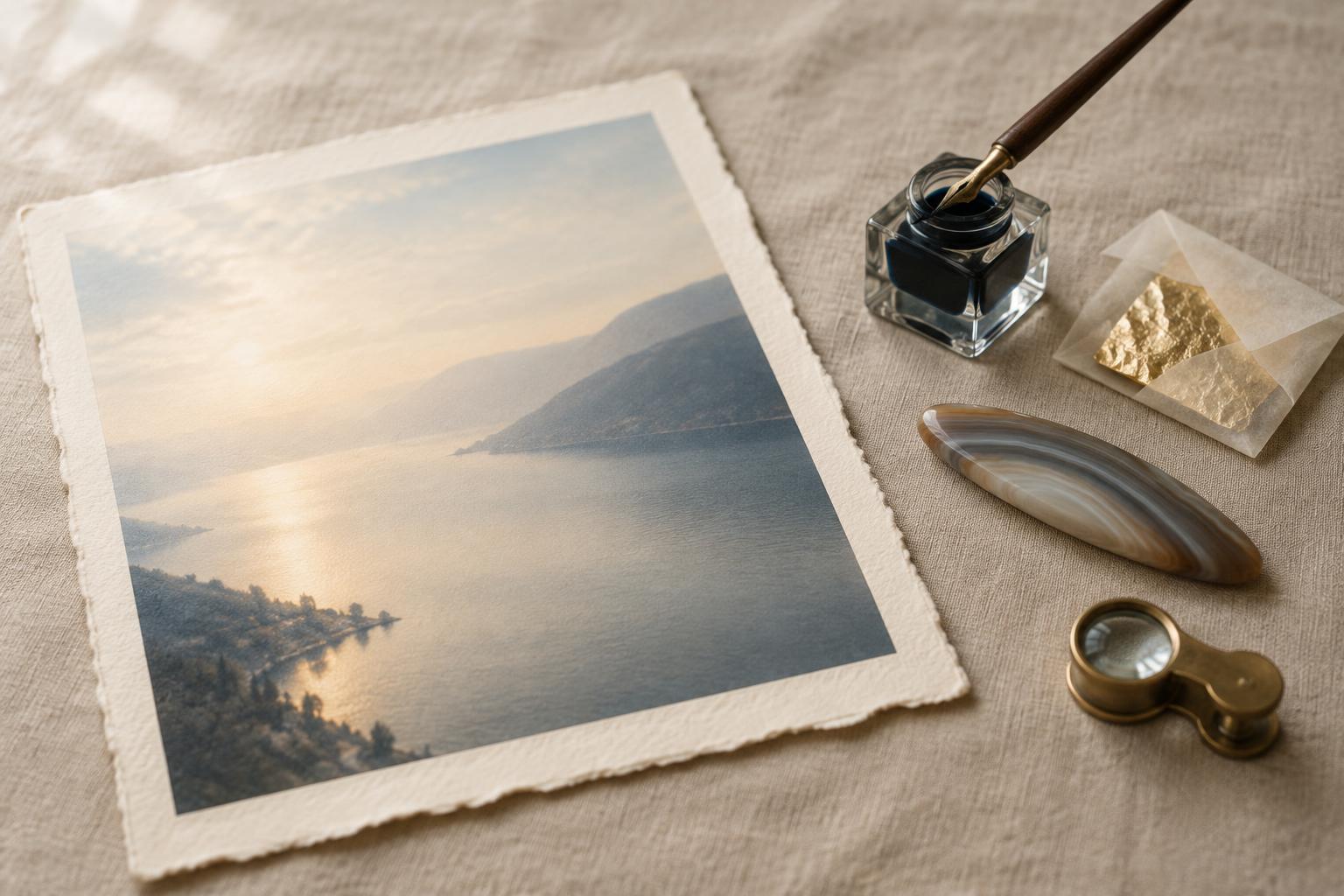
We are photographers, first. That matters, because we are not artists in the general sense and not hand printers of any kind. What we do is narrower and, we think, more useful: we make the photograph, and then set the words with it.
We are photographers, not hand printers. The text on each piece is set in an elegant typeface — one of the fine faces available today that can stand beside a photograph — and it is set with the photograph itself, so the picture and the words are read together. Nothing on a piece is lettered, written or drawn by hand. The text is chosen or written for the person, drawn from a monastic source and cited where it comes from somewhere else. Then the picture and the words are composed together, so the eye takes them in as one thing.
Most of the writing is our own — set down for one occasion and for no other. Where we have drawn on a monastic thought, it is cited on the piece, so the words are credited to the hands that kept them. The photographs are our own, made for the occasion or drawn from the collection we have been building for years — a sun through bare trees touching the water of a pond; a window in a Boston parish that has stood in the same place for well over a century.
Heraldry
And a second discipline,held to the same standard.
We also take on heraldic work, ecclesiastical and secular: new coats of arms, and the correction and proper definition of existing ones.
Heraldry is an exact art. A charge in the wrong position is a different coat. A tassel too many is a claim to an office. We work in the classic hand, in flat and traditional colour, and we would rather tell you your arms are already right than draw you something more elaborate.
On the Rogito
“For a funeral we write a Rogito — the same form of record that is commissioned at the death of a Pope. Two copies are printed: one remains with the person, and one goes to the family. It is written for one person and for no other, and the Rogito for a member of the laity, or of a Third Order, is a noticeably different piece from the one written for someone who was ordained or who had professed religious vows, because the life it records is different.”
Some families do not want a Rogito at all. They send a photograph of the person — a portrait, a favourite day, a face they want to keep looking at — and it is set with a monastic contemplation cited on the piece, because at that hour the words prayed over the dying for a thousand years say it better than anything new.
Let us make a piece for the moment.
Every piece is made to order: a photograph of your own, your names, your date, your words — set together as one piece. Tell me about the occasion and I will write back with a design.
Begin a commission